
How to find your car's color code and verify it's the right one
The car paint code (paint code) is the technical identifier that links a vehicle to the exact body paint formula. It is the reference used by paint manufacturers to recreate the vehicle's original shade during touch-ups, repairs and refinishing.
Knowing where to find the car paint code, how to read it correctly and how to check the shade before painting helps avoid mistakes caused by trade names, formula variants and visual differences due to wear, clear coat or application technique. The label location and the code format change for each manufacturer: if you're looking for the paint code of a specific brand, see the brand-by-brand search guide.
- What is the car paint code and why is it the correct reference for choosing paint?
- Where is the paint code on my car and how do I recognize it without making mistakes?
- Why isn't the color's trade name enough to order paint?
- Why can the color look different even if the code is correct?
- How can I check before painting that the chosen color is the right one?
- How do I do a truly useful color test before a touch-up?
What is the car paint code and why is it the correct reference for choosing paint?
What is the car paint code?
The car paint code is the identifier used by manufacturers to determine the body paint formula. Each code corresponds to a precise combination of pigments that makes it possible to reproduce the vehicle's original shade.
When you need to do a paint touch-up or a local repair, the paint code is the right starting point because it links your car to a verifiable technical formula, not to a generic description like ?metallic red? or ?dark gray?. However, the code alone does not guarantee a perfectly identical result to the existing bodywork: touch-up paint is a technical reconstruction of the factory shade and can be affected by production variants, surface aging and application differences.
Does the paint code also indicate which clear coat to use?
The paint code identifies the pigmented base of the paint and not the protective clear coat applied on top. The clear coat is a separate layer of the paint system and is chosen based on the system used for the touch-up.
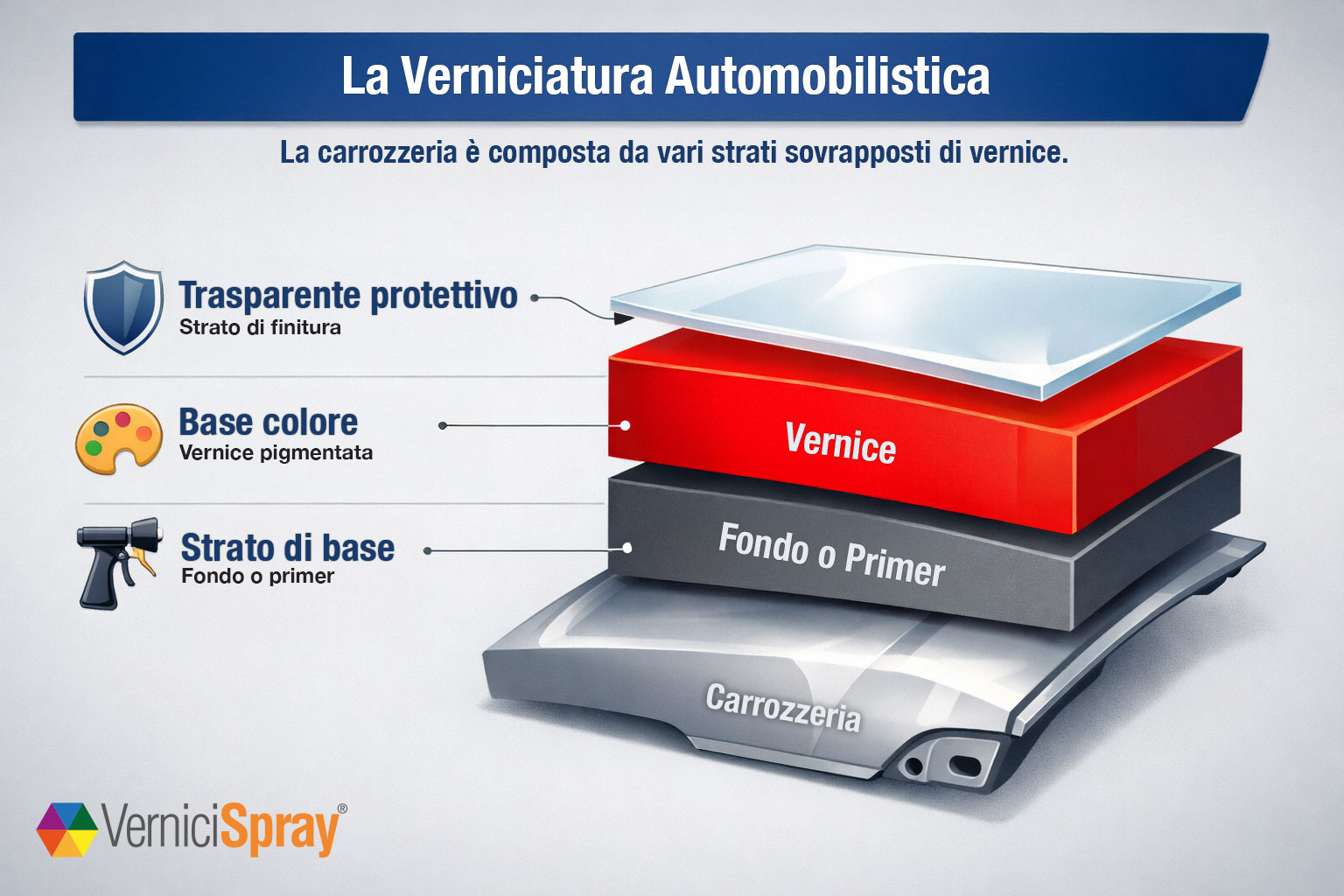
Modern automotive refinishing is almost always a multi-layer system consisting of primer, color base and final clear coat. The color perceived on the bodywork therefore depends not only on the shade but also on how the clear coat reflects light, on its gloss and on its condition. Over time the clear coat can get scratched, dull or oxidized, changing the perception of the underlying color.
Why doesn't the paint code always guarantee a perfect match?
Even with the correct paint code, the touch-up shade may look slightly different from the original bodywork. This happens because production variants, different suppliers and the actual condition of the surface change the final color result.
Car makers build vehicles in different plants and over time may use paint bases that are not perfectly identical while keeping the same official code. Some colors also have multiple formula variants developed over the years. The paint manufacturer reconstructs the shade starting from samples and instrument measurements, often with the help of a spectrophotometer, but a very precise technical reproduction does not always coincide absolutely with the current appearance of the bodywork. The eye can also be misled and, in any case, the fact that the instrument detects a color match does not automatically guarantee perfect visual uniformity on the vehicle. To improve the final result, generally blending and other techniques are used.
What is the most reliable way to choose the right paint?
The most reliable method is to combine the correct paint code, verification of the purchased product and a color test on a sample. None of these steps, taken on its own, is sufficient in all cases.
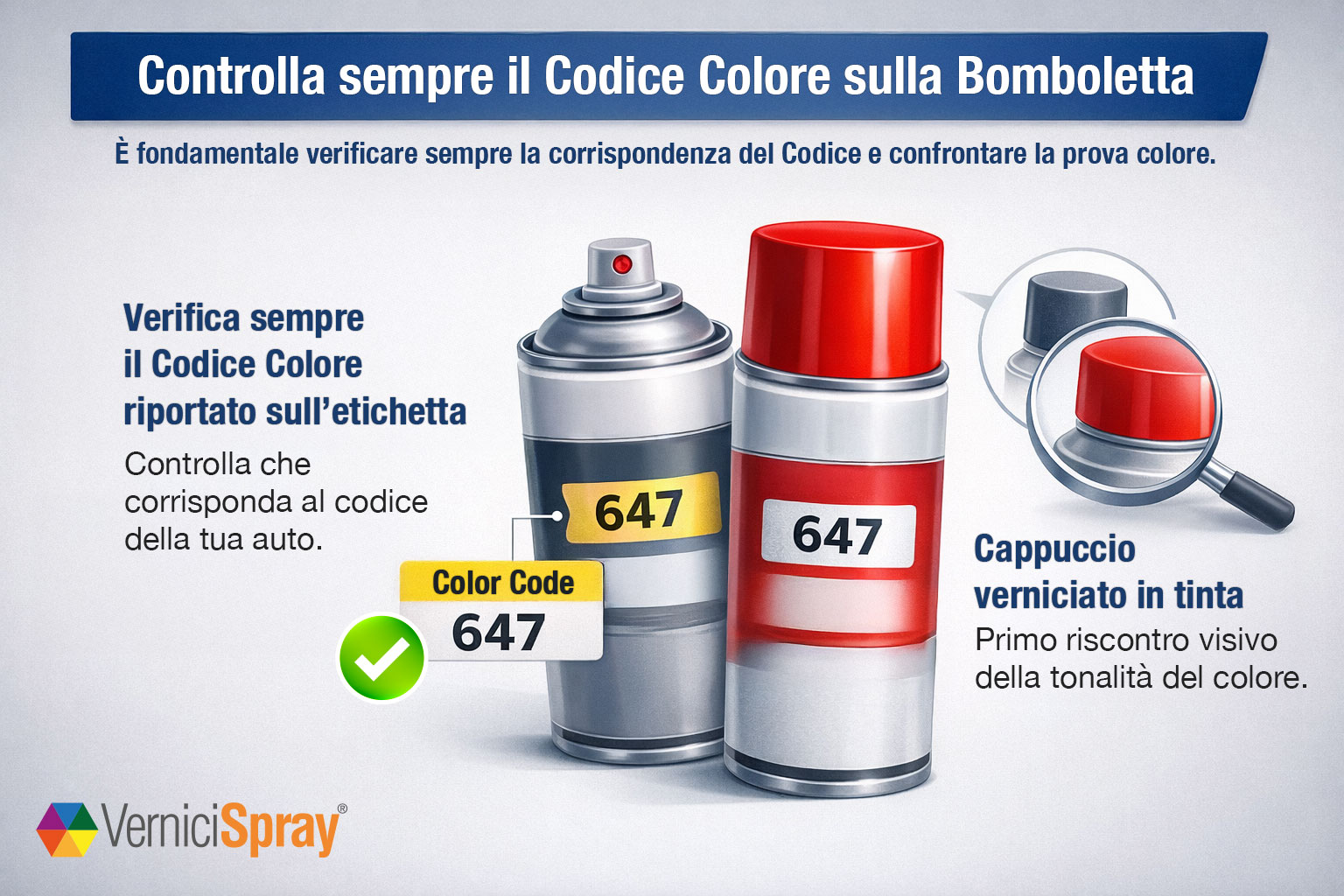
In practice you need to identify the car's official code, check that the same code is shown on the can you bought, and finally check the real shade result on a test surface. To make this step easier, some manufacturers add an immediate visual reference: VerniciSpray, for example, in addition to showing the paint code of the original formula, applies a light coat of real paint on the cap of the spray can. This makes it possible to get a first visual confirmation of the tone even before spraying. This complete approach is especially important when the color has known variants, when the car has aged, or when working on metallic and pearlescent finishes, where the final optical effect also depends on how the paint is applied.
In summary: The paint code identifies the formula of the pigmented base. The clear coat is a separate layer and the final result also depends on wear, application and surface conditions. In any case, when choosing the clear coat, it is essential to understand the differences between 1K and 2K clear coat to know how to choose it.
Where is the paint code on my car and how do I recognize it without making mistakes?
Where is the car paint code located?
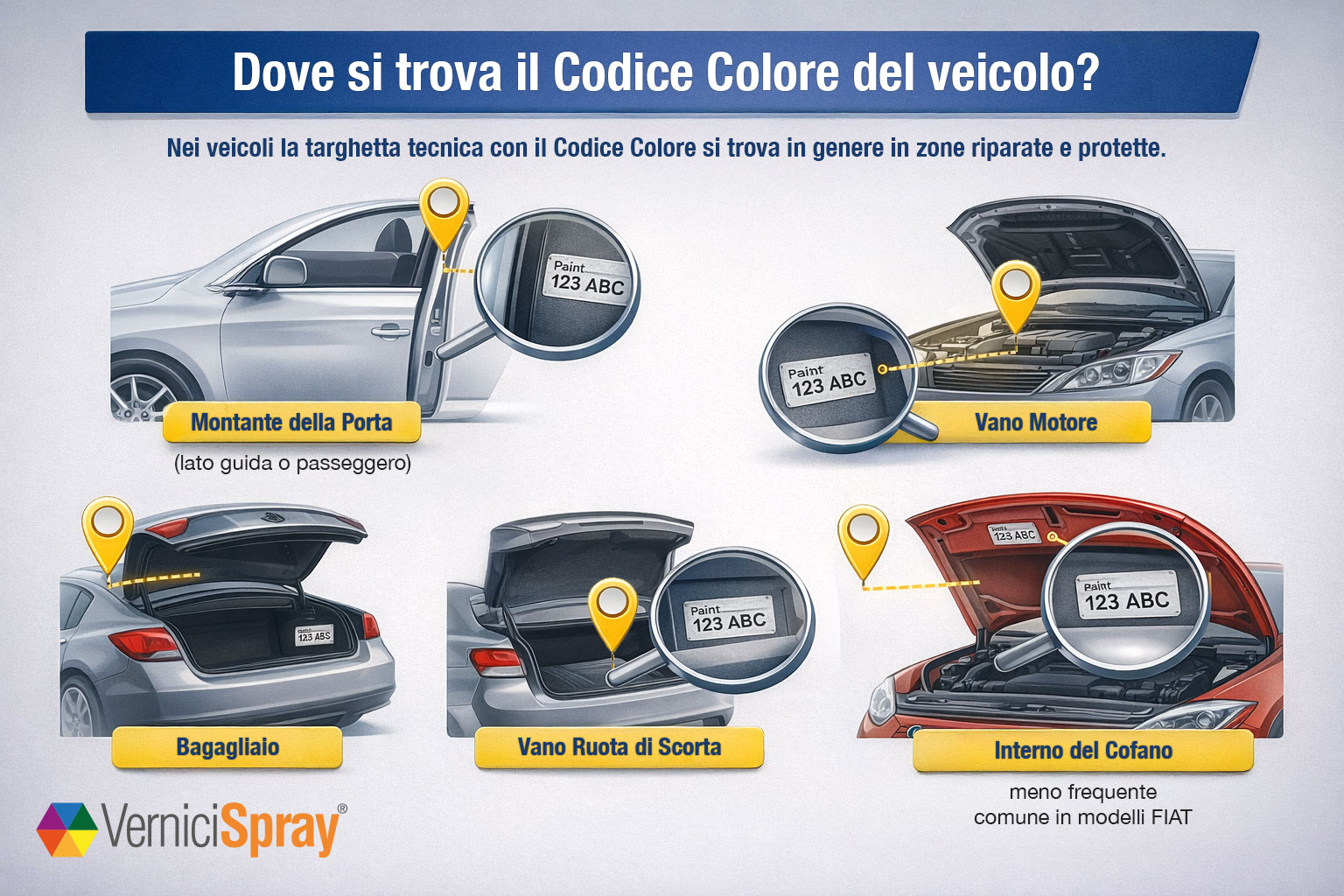
The car paint code is shown on the original technical label applied by the manufacturer on the bodywork. The most common locations are the door jamb, the engine bay, the trunk or the spare wheel well.
These labels are placed in relatively protected areas so they remain readable over time. The most frequent points are the door pillar on the driver or passenger side, the engine bay bulkhead, the inner sides of the trunk or the spare wheel compartment. As soon as you find it, it's advisable to photograph it: a sharp photo lets you zoom in on details and avoid transcription errors.
How do I recognize the paint code without confusing it with other codes?
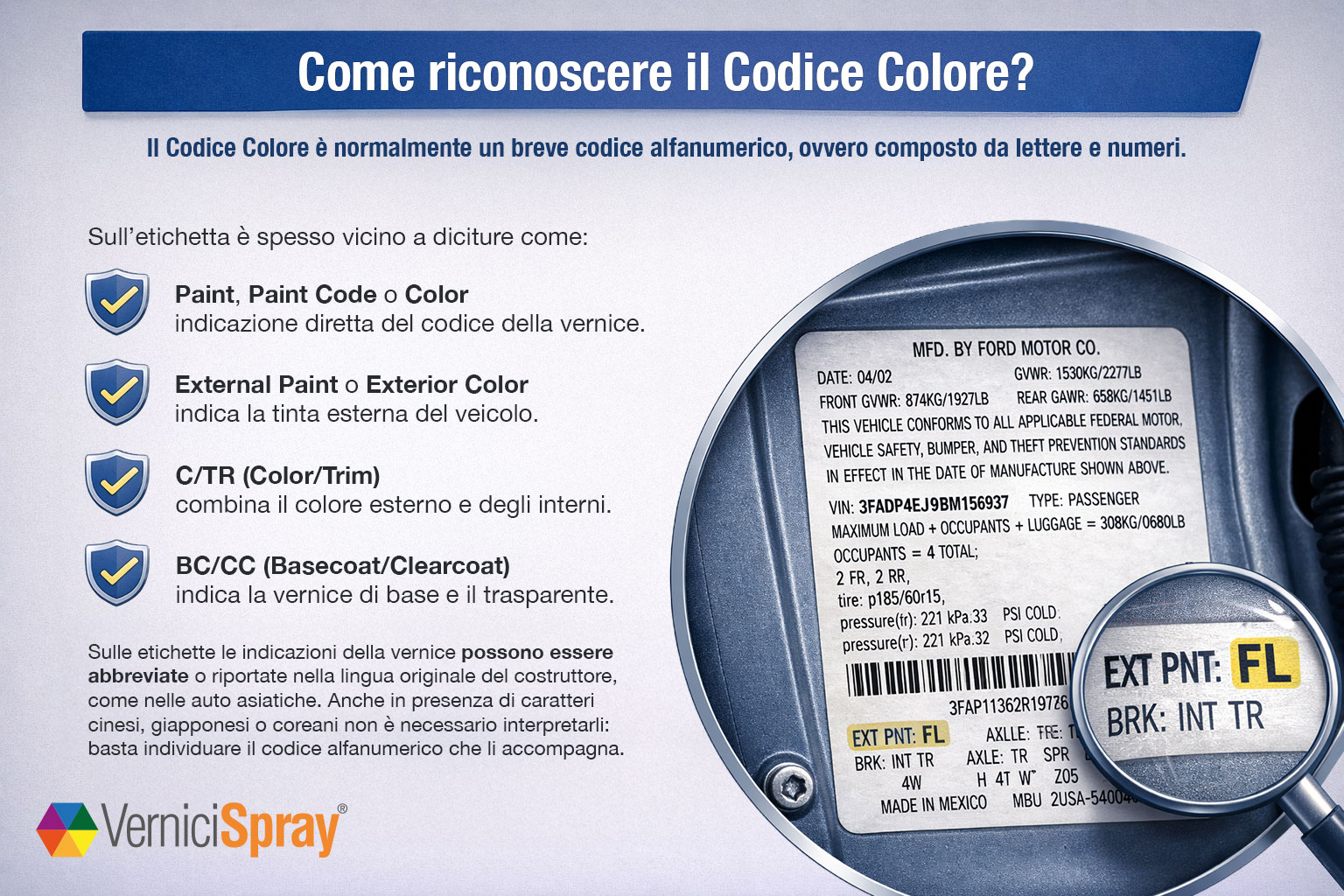
The paint code is usually a short alphanumeric code shown on the label next to wording such as Paint, Paint Code, Color, Exterior Color, or their abbreviations such as Pnt. or Ext. Pnt..
On some technical labels you may also find the abbreviation C/TR (Color / Trim). In this case, the same field contains both the body paint code and the interior trim code. It is therefore important to distinguish the paint code from the interior code.
The wording on the label may also be in the manufacturer's original language. On some Asian cars, Chinese, Japanese or Korean characters may appear, but there is no need to interpret them: to identify the shade, it's enough to find the alphanumeric paint code.
Does the registration document include the paint code?
In European countries, the registration document may show the vehicle color, but this almost never matches the technical paint code used by the manufacturer. At EU level there is a harmonized reference, the field R, which indicates the vehicle color as descriptive or administrative data, not the formula or OEM code needed for a precise touch-up. In addition, each country may handle this information differently: the color may be present, absent or indicated in a generic form, and even when a code associated with the color appears it is not necessarily the true manufacturer paint code.
| Country | Color in the document | How it is reported | Usefulness for the paint code |
|---|---|---|---|
| Austria | Yes | Color indicated in the vehicle data | Generic information, not a paint code |
| Belgium | Yes | Color registered in the vehicle data | Administrative data, not technical |
| France | Variable | The document is not a standardized source for identifying the paint code | Not reliable for obtaining the paint code |
| Germany | Yes | Field R indicates the vehicle color; in Field 11 an administrative color code may appear | Field R provides generic descriptive information; the code in Field 11 is not the manufacturer's OEM paint code |
| Ireland | Yes | Color registered in the vehicle data | Not sufficient to identify the paint code |
| Italy | Yes | Field R indicates the vehicle color | Generic descriptive information, not usable to identify the paint code |
| Netherlands | Yes | Color registered on the certificate | Not usable for precise identification |
| Portugal | Yes | (R) Cor do veículo | Descriptive data, not technical |
| United Kingdom | Yes | Colour on the V5C | Generic information, not a paint code |
| Spain | No (generally) | The color does not appear among the main data in the document | Not usable |
In practice, even when the color is shown in the registration document, it is almost always information that is too generic to accurately identify the vehicle's original shade. To obtain the correct paint code it is therefore necessary to consult the vehicle identification label, following the brand's conventions, or use the manufacturer's databases via the chassis number (VIN). Online services that estimate the color starting from the license plate can be useful as a preliminary reference, but they do not guarantee a reliable identification.
In summary: The paint code is found on the car, generally never in administrative documents. Look on the label for ?Paint? or ?Color?. The exact location changes for each brand: the brand-by-brand paint code search guide explains where to look and how to read the code correctly for each manufacturer.
Why isn't the color's trade name enough to order paint?
Should I use the trade name or the paint code to order paint?
To order the correct paint you must use the paint code and not the color's trade name. The trade name is a marketing description, while the code links the car to a verifiable technical formula.
Names like ?ice white?, ?cinema black? or similar expressions can change over time, vary from country to country or be used not perfectly consistently across different models. By contrast, the paint code is the reference used by paint manufacturers to recreate the shade. Even online images or catalog photos are not sufficient to choose the right paint, because screens, lighting, compression and post-production alter the visual result. In localized touch-ups the difference between a ?similar? color and the correct color is huge: the defect remains surrounded by the original paint and any mismatch is immediately visible. For this reason, the trade name can help you get oriented, but it must never replace the paint code.
In summary: Trade names are unreliable and subject to marketing strategies. The only scientific parameter is the alphanumeric code on the label. If the car has been restored and no longer retains the original color, it is possible to obtain the paint formula by analyzing the shade with a spectrophotometer.
Why can the color look different even if the code is correct?
Why can a touch-up look different even with the correct code?
Even with the correct paint code, the touch-up shade may look slightly different from the original bodywork. This happens because production variants, clear coat aging and application technique change the visual perception of color.
Many colors exist in multiple variants developed over time due to batches, suppliers or formula updates, and the difference can become evident especially on grays, silvers, blues, metallics and pearlescents. In addition, the bodywork does not keep the same appearance as the day it left the factory: the clear coat gets micro-scratches, becomes dull, changes how it reflects light and can make the color look flatter or less deep. Added to this is the spray technique: in metallic and pearlescent finishes, the orientation of the pigments, the distribution of the flake and therefore the final visual effect change a lot. In practice, when you say ?the color is different?, you are often observing shade, finish, clear coat and optical effect together, not just the basecoat formula.
How can I tell if the mismatch depends on the shade or the finish?
If the mismatch changes a lot depending on the light angle, the problem often depends on finish, texture or clear coat rather than the pure shade. If instead the difference remains stable in every condition, a real variation in formula, hiding power or color variant is more likely.
This distinction is important because it avoids wrong diagnoses. A smoother, glossier surface reflects more specularly and looks more intense; a matte surface diffuses light and looks duller or ?grayer?. For this reason, a well-executed polish, when the panel allows it, can greatly reduce the perception of mismatch without changing the shade at all. If instead the sample remains consistently lighter, darker, warmer or cooler, then the issue is more likely in the color variant, in the primer used under the basecoat, or in the number and evenness of coats applied.
In summary: A visible touch-up doesn't mean you bought the wrong spray can. Dulling of the old clear coat, the plastic substrate and spray technique profoundly alter the optical result.
How can I check before painting that the chosen color is the right one?
What checks should I do before spraying the paint?
Before painting, it's best to verify both the technical data and the visual result. The data check prevents code errors, while the visual check catches variants, repainting and finish differences.
In practice you should start with a sharp photo of the label and check that the transcribed code matches exactly the one shown on the product you purchased. Right after that, it's worth asking yourself whether the vehicle has been repainted, whether the model has had a facelift, which paint system you're using and what condition the surface to be repaired is in. A heavily marked clear coat, a basecoat applied without proper method, or a spray can that's too cold can distort the perception of the result even when the code is correct. The larger the job, the more decisive these checks become. The point is not only ?having the right code?, but understanding whether the car's real-world context allows that formula to look consistent with the rest of the bodywork.
In summary: Always cross-check the code on the spray can with the photo of your label, make sure you're using the correct paint system (direct gloss or base + clear coat), and assess the real condition of your panel.
How do I do a truly useful color test before a touch-up?
Why is it important to do a color test?
The color test is a preliminary test that allows you to verify the real match between the purchased paint and the vehicle's bodywork before applying it to the panel.
Spraying a sample on a support similar to the car's surface makes it possible to evaluate shade, coverage and effect in natural light. This step is particularly important for metallic or pearlescent colors, where the final result also depends on pigment orientation and spray technique.
What support should I use for the color test?
The ideal support for the color test is a metal test panel or a rigid surface prepared in a way similar to the actual panel. Cardboard, plastic or other supports can melt, absorb the paint or alter pigment orientation (in the case of metallics or pearlescents, this is common). A test on unsuitable supports can, essentially, distort the perception of the color.
If the paint cycle includes primer and clear coat, the sample should also be prepared in the same way. Only then will the comparison with the bodywork be reliable. If you use a two-component, or 2K, clear coat that requires activation with a hardener, for a preliminary test it may be convenient not to activate it immediately. This helps limit waste, because once catalyzed the product has a limited pot life and, if it isn't used, it may no longer be reusable properly.
How do you evaluate the sample correctly?
The sample must be observed in natural light and from multiple angles. The correct comparison concerns hue, brightness and the color effect.
With metallics and pearlescents you must also check the flake and the way the surface reacts to light. The evaluation should not be limited to a quick impression but should check whether the sample reacts to light in the same way as the original panel.
In summary: A color test performed on a rigid support and evaluated in natural light helps avoid mistakes before painting the car. After identifying the paint code, the next step is choosing the most suitable tool for the touch-up: spray can or brush. In the dedicated guide we explain when to use each solution.
Frequently asked questions and special cases about car paint codes
These questions concern particular situations that can create doubts during paint code identification or during paint testing.
About the paint code
Does the paint code also include the paint for alloy wheels?
No. The body paint code is separate from the one used for alloy wheels. Wheels can have different codes or use standard shades.
About the vehicle label
What should I do if the label is damaged or illegible?
If the label is damaged or covered with paint, the most reliable solution is to contact an official dealer and provide the chassis number (VIN). For repainted vehicles, classic cars or brands that are no longer active, the OEM code may not be sufficient: in these cases, professional tools such as a digital colorimeter are used. The brand-by-brand search guide describes both paths in detail.
Do two-tone cars have two paint codes?
It depends on the manufacturer. Some indicate two separate codes, while others use a single code that identifies the pairing of shades.
About the color test
How long should I wait before evaluating the color test?
Evaluation should be done only after the sample has completed the drying time required by the applied system, and preferably in natural light. If the test includes basecoat and clear coat, the comparison should be performed only once the finish is complete.
Can I use the plastic from a bottle, a piece of cardboard, or another surface for the color test?
No. Using improvised supports alters the results. Cardboard absorbs solvents, darkening the shade, while common plastics can melt or alter refraction. The only reliable tool is a metal test panel specifically for color tests, because it provides a rigid support and an application surface closer to bodywork than cardboard or common plastics.
What should I do if the color test doesn't match?
Check that you shook the can for at least two minutes to mix the pigments and that you used the correct code. If the difference remains evident, you may have a factory variant that differs from the standard sample.